For anyone who designs audio equipment, measurement is a powerful ally. Numbers make results repeatable, give performance claims their footing, and show where to test and improve next. At KuraDa we do not doubt the value of measuring frequency response, distortion and transient response. If anything, we are exacting about it.
And yet we hold to this as well: not everything about sound can yet be put precisely into numbers. We assume there are regions that measurement cannot fully describe. Giving those uncertain regions a shape, through listening and engineering together, is the designer’s responsibility, and the designer’s challenge.
“Good sound” is still being defined.
Bringing perception into the design
Encountering psychoacoustics
KuraDa turned seriously to psychoacoustics because of a question that would not go away. Each time we changed the structure, the impression of the sound changed with it, unmistakably. We felt it day after day.
Change the angle of the earpad by a few degrees. Adjust the airflow through a vent slightly. Use a different material for an acoustic filter. The sound turns “brighter” or “more distant”, “more natural” or “less tiring”. But why it feels that way, and which part of the structure is doing what, was often more than the change in a measurement graph could explain.
In most cases, a measurable difference was there to be found. How that physical change arrives in the listener as an experience was another matter, and there lay the wide gap between measurement and perception. From psychoacoustics, our interest spread to its neighbours: sensory engineering, cognitive psychology, auditory physiology.
- Masking and critical bandsSounds close in frequency interfere with each other, affecting clarity and separation
- Fine spectral shape and loudness perceptionSmall peaks and dips are linked to harshness, muffling and listening fatigue
- Spatial perception based on HRTFsCreates individual differences in how imaging and soundstage are perceived
- Perceptual compensation through experienceMemory, attention and expectation change what we hear
We did not stop at theory; we began to use these ideas as design tools. Rather than leave an impression as an impression, we set about defining it as a structural element that can be reproduced.
Putting sensation into words, and into structure
What happens in our design process
Suppose a very small change to the acoustic filter material makes the upper mids of a prototype feel less harsh. What exactly was that harshness? Which measured parameters moved? Which element of perception does it touch? We check each one, then build the answer into the design as a structural element we can reproduce.
Earpad shape, driver angle, chamber volume, vent airflow: through both measurement and listening, we observe in detail how each affects imaging, soundstage and transient response, and we record what we find. It is patient work. Its purpose is to widen, one case at a time, the ground on which we can say with confidence: “this structure gives this sound.”
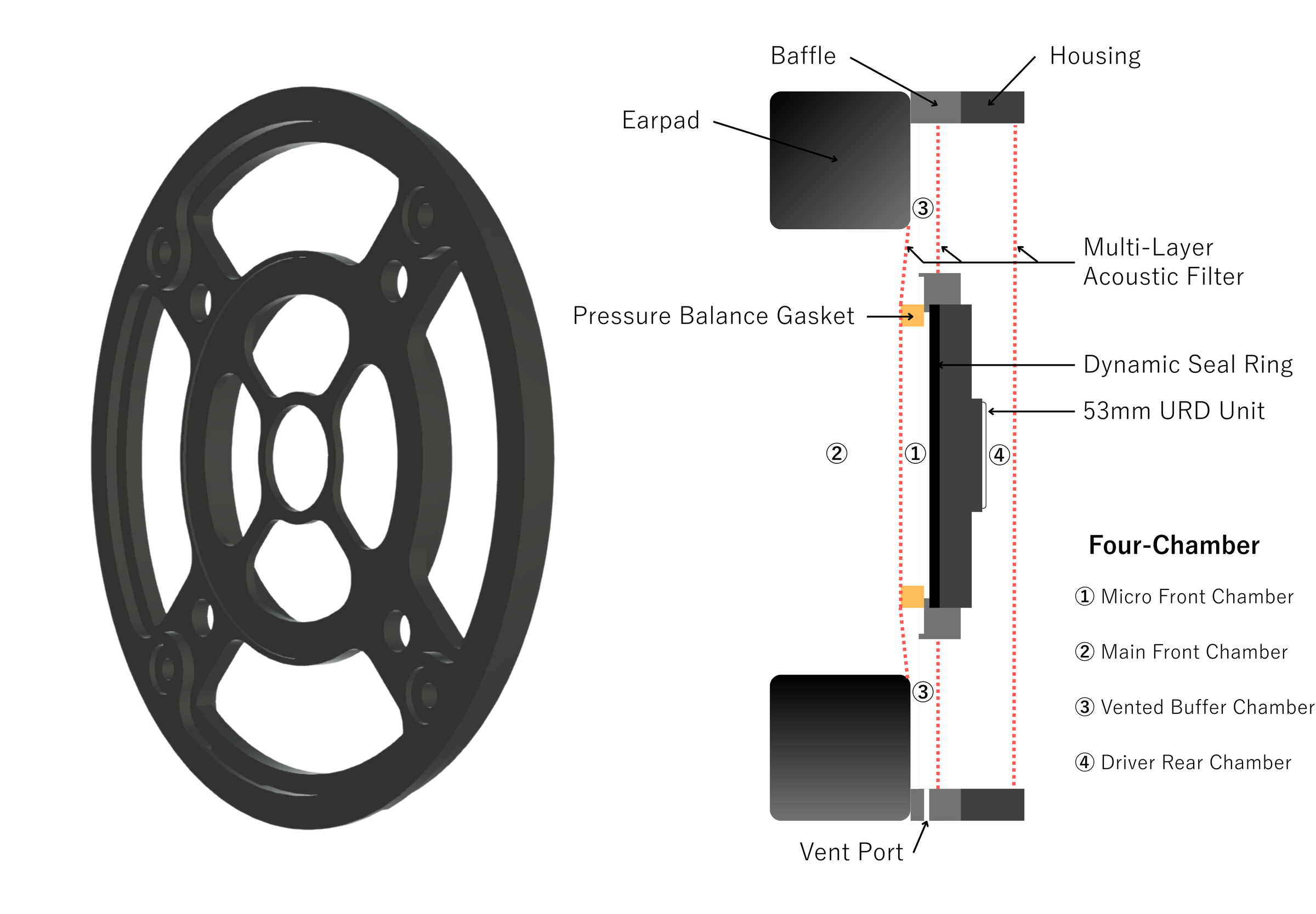 KD-Q1Cross-section of the four chambers
Numbers are where the question begins
Good sound cannot be described by better numbers alone
THD+N, frequency response, transient response, cumulative spectral decay (CSD): all are essential for capturing sound quantitatively. KuraDa measures them accurately and builds on them.
Even so, we do not believe that excellent measurements lead directly to good sound. Distortion close to zero does not guarantee comfort. A flat frequency response does not guarantee a natural sound. The numbers show fragments of what is physically happening; they do not reach the “transformation” by which human perception takes it in.
Giving structural form to what numbers cannot fully show.
A sensation that can be reproduced
What KuraDa aims for
Our aim is not a good sound arrived at by chance. It is a sensation that can be reproduced. “At this angle, the image moves naturally forward.” “With this airflow structure, listening is less tiring.” We do not leave discoveries like these as rules of thumb. We build them into the structure, so that the next thing we make is felt in the same way.
What can be measured and what cannot both belong to the design. That is where we stand.
Making things without dismissing perception
No one has yet fully defined “good sound”. Even so, we believe that when people find a sound comfortable, natural or less tiring, there is always a reason. Measurement captures part of it.
That is why KuraDa, drawing on psychoacoustics and its neighbouring fields, has chosen to turn the space between measurement and perception into design, one step at a time. To be faithful to science and to sensibility alike: that is our stance.